
Commercial Diving Support in Los Angeles: Inside the Ballona Creek Interceptor Marine Operations
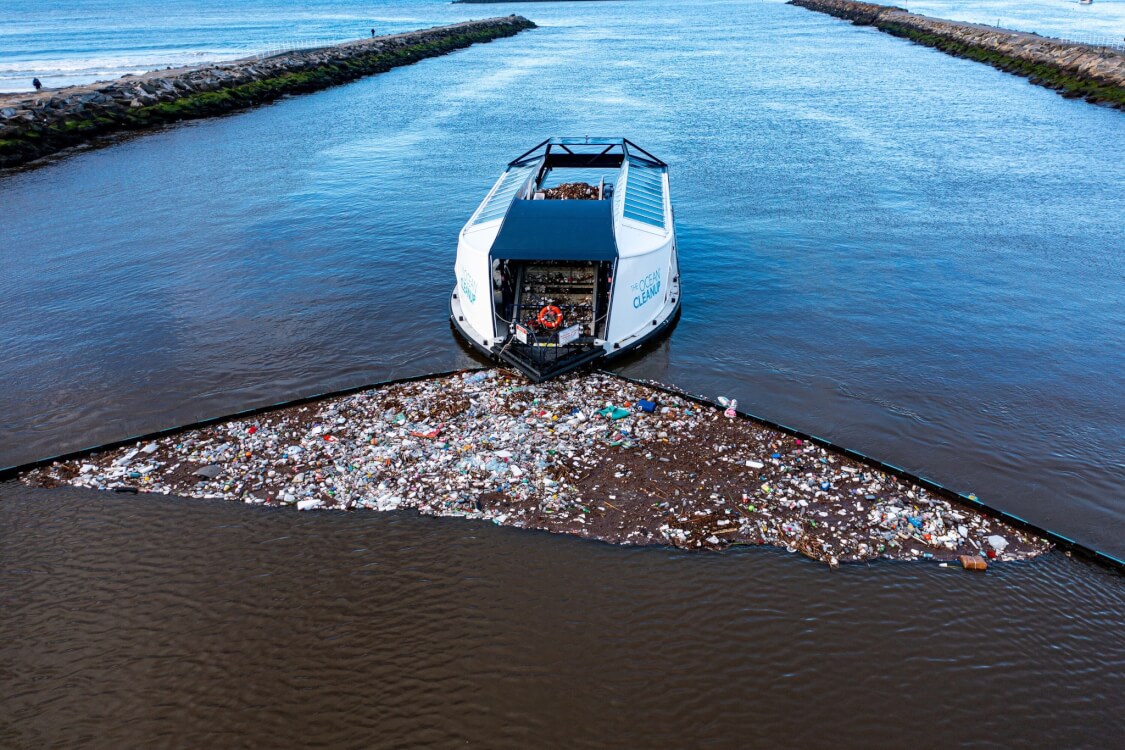
When The Ocean Cleanup deployed Interceptor 007 at the mouth of Ballona Creek in October 2022, it became the first river-plastic capture device of its kind in the United States. What the press coverage rarely shows is the commercial dive work that keeps it running. Myers Marine Division provides ongoing marine services for the Interceptor barge system, including emergency response, barge transport and swap operations, marine growth removal, cathodic protection installation, and underwater chain and rigging replacement.
This is one of the most environmentally significant projects on our roster, and one of the most technically demanding. Ballona Creek is a flood-control channel with zero visibility on most working days, extreme tidal and storm-surge currents, and peak flows that have reached 18,000 cubic feet per second during atmospheric river events. Every dive on this site happens under conditions that disqualify most commercial dive operations.
What We Were Up Against
Ballona Creek discharges directly into Santa Monica Bay through a hardened concrete channel lined with riprap. The water column is a moving wall of urban runoff, sediment, and debris carrying everything from automotive fluids to micro-plastics. Working conditions on this site include:
- Visibility consistently at 0 to 6 inches, requiring full reliance on touch, dive-tender communication, and surface-supplied audio
- Current velocities that spike sharply during and after storm events, with documented peak channel flow of 18,000 CFS
- Sediment-loaded water that abrades chain links, rigging hardware, and anode mounts faster than standard tidewater installations
- A working footprint constrained by the Interceptor's mooring geometry, the north and south jetty walls, and active boom hardware
- Community shoreline directly adjacent to the work site, requiring zero-incident environmental discipline on every dive
On top of the physical conditions, the operational tempo is unforgiving. Interceptor 007 has completed more than 20 trash offloading cycles during its pilot period, and each one requires synchronized barge handling. When an inner barge fills, our crew untethers it from the Interceptor, transports it down the channel to a staging crane, supports the crane offload, and returns the cleaned barge to the system. None of this stops because conditions are bad. When the system needs service, the dive team goes in.
Dive Plan and Execution
Every operation on the Interceptor is built around ADCI Consensus Standards for Commercial Diving and Underwater Operations, with surface-supplied air as the only acceptable diving mode for this site. SCUBA is not used. Each dive runs under full ADCI and OSHA 29 CFR 1910 Subpart T compliance, with a dive supervisor topside, a standby diver in-water-ready, and continuous voice and pneumofathometer communication.
Our scope on the Interceptor program includes four distinct service categories, each with its own dive plan:
- Marine growth removal. Divers work the submerged steel and aluminum surfaces of the Interceptor hull, anchor points, and mooring chains using hand scrapers, underwater grinders, and hydroblasting equipment operating in the 10,000 to 40,000 PSI range depending on substrate.
- Containment boom open/close cycling. The trash booms are deployed in a V-formation toward shore during low-flow community-demand periods and stowed during high-flow storm events. Divers manipulate boom connection hardware in current, frequently by feel alone.
- Underwater cathodic protection installation. Sacrificial zinc and aluminum anodes are bolted to submerged structural members to protect against galvanic corrosion in the brackish saltwater-freshwater mixing zone at the creek mouth. Anodes are inspected on a scheduled cycle and replaced before reaching their wastage threshold.
- Chain and rigging replacement. Mooring chains rub against the sandy riprap-lined bottom, abrading the links at predictable wear points. Worn links are cut underwater using hydraulic chain cutters, replaced with rated hardware, and re-tensioned against the load on the mooring system.
Diver safety in extreme current is managed with heavy weighting, secured down lines, and hogging lines rigged from fixed points to anchor the diver against flow. A diver who loses purchase in this channel does not get a second chance to grab the structure, so the rigging plan is engineered before anyone enters the water.
All work is staged from a small vessel platform equipped with a full surface-supplied dive spread, including an air compressor, volume tank, communications panel, and a redundant secondary air source. Per ADCI and OSHA standards, no diver enters the water without a fully redundant gas supply and a topside-monitored umbilical.
Equipment in Focus: Surface-Supplied Diving in Zero-Visibility Current
This site is not a SCUBA site, and it is not a place for shore-supported operations. The dive spread that makes the Interceptor program possible includes:
- Surface-supplied air helmets with hardwired through-water communications
- Diver umbilicals carrying gas, comms, pneumofathometer line, and strain-relief tending
- Hydraulic power packs topside feeding underwater grinders, chain cutters, and hand tools
- Hydroblasting units rated for marine growth removal on coated and uncoated steel
- Hand scrapers and brass-bristle tools for finishing work where high-pressure equipment would damage protective coatings
- Dual-station communications topside so the supervisor can monitor the working diver and the standby diver simultaneously
- A small-vessel deck barge configured to operate inside the constrained Interceptor footprint without disturbing mooring geometry
Equipment is maintained on a documented scheduled-service program per ADCI Consensus Standards Section 4 and OSHA equipment inspection requirements. Fully redundant systems are a non-negotiable baseline for every operation in this channel.
Results & Impact
The Ocean Cleanup originally projected that Ballona Creek emitted roughly 14 tons of plastic and debris per year before deployment. Actual first-year capture came in at 45 tons. The second-year haul cleared 122 tons. As of the most recent reporting, Interceptor 007 has prevented over 193 tons (more than 386,000 pounds) of trash from reaching the Pacific Ocean since October 2022. The marine support work behind those numbers is invisible to the public, but the system does not run without it.
The pilot was declared a monumental success by Los Angeles County, and the Board of Supervisors voted unanimously in 2024 to make Interceptor 007 a permanent installation. The Ocean Cleanup has now announced expansion into the Los Angeles and San Gabriel Rivers, with a new and larger Interceptor planned for the mouth of the LA River within 18 months. Myers Marine Division has been consulting on the marine logistics of that upcoming installation.
Beyond the tonnage, the human signal matters. Joggers, surfers, and Marina del Rey residents stop our crews on the jetty to thank them for cleaner beaches. That kind of feedback does not happen on most commercial dive projects. For more on our environmental and infrastructure work, see our full services overview and our about page for our team's certifications and safety record.