
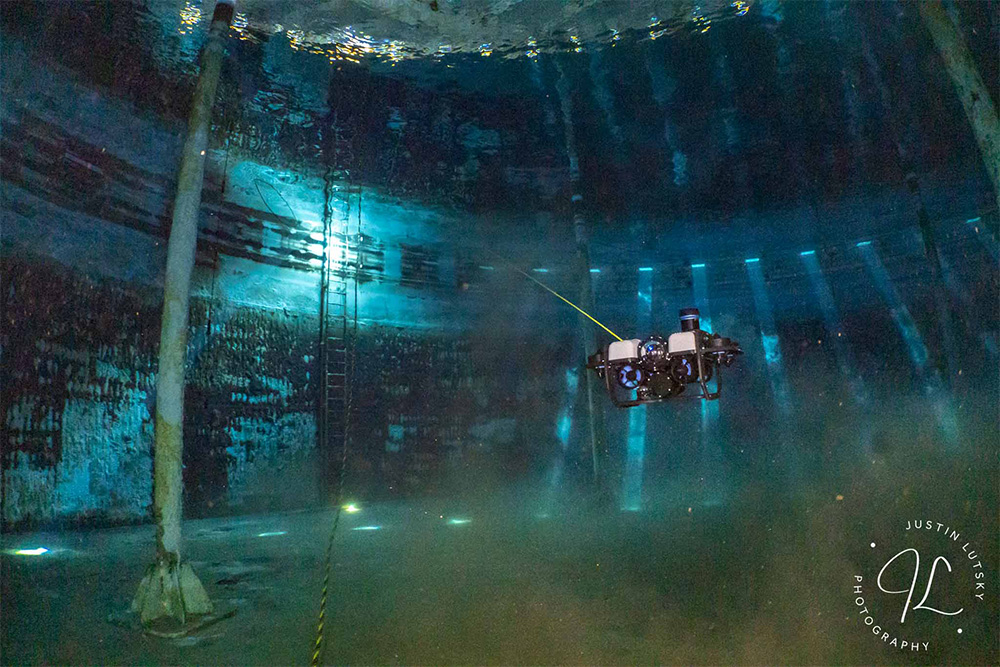
UC Riverside Water Tank Inspection: A Decade-Overdue Survey of the Campus Potable and Fire Supply
UC Riverside operates one of the largest research campuses in the University of California system, and that scale brings infrastructure obligations most students never see. The campus maintains its own independent water supply: large-volume potable water tanks that deliver drinking water to academic buildings, residence halls, and laboratory facilities, and that double as the dedicated fire suppression reserve for the campus. When a laboratory fire breaks out, the on-site reserve is the difference between a contained incident and a catastrophic loss. Those tanks had not been inspected in more than a decade.
Myers Marine Division was contracted to perform a full potable water tank inspection in Riverside, CA, surveying the interior condition of the tanks, evaluating the cathodic protection system, collecting sediment samples for contamination screening, and delivering a documented condition report the university could use to plan maintenance and capital work. The job combined surface-supplied commercial diving, ROV-assisted internal imaging, in-tank core sampling, and remote-site mobilization up a fire-access road. Every dive was executed under ADCI Consensus Standards and AWWA potable water tank inspection protocols.
Site Conditions on Arrival
The first complication was access. The tank site sits at elevation on the UC Riverside campus, reached only by a graded fire road with no paved staging. Before any inspection work could begin, our crew mobilized a full surface-supplied dive spread to the location: the mobile dive command unit, low-pressure breathing-air compressors, primary and secondary umbilical reels, comms, decontamination staging, and core-sampling tooling. Transporting redundant life-support to a remote campus elevation is not a logistics afterthought. It is the dive.
Conditions inside and around the tanks included:
- Multiple large-volume welded steel potable water tanks, full and in active service, supplying both campus drinking water and the dedicated fire suppression reserve
- More than 10 years since the last documented interior inspection
- No drawdown permitted; tanks remained online throughout the inspection in line with AWWA C652 disinfection considerations and university service-continuity requirements
- Unknown interior coating condition, anode wastage, and sediment depth at project start
- OSHA 29 CFR 1910.146 permit-required confined space classification, layered with 29 CFR 1910 Subpart T commercial diving requirements
- Remote staging with no immediate municipal services, requiring fully self-contained breathing air, comms, and emergency egress
The combination of a decade of unknown wear, an active in-service tank, and a confined-space dive entry above grade meant every system on the truck had to be redundant before the first diver touched water.
Engineering the Inspection
The work was executed by surface-supplied air divers entering each tank through the roof manway. Surface-supplied was the only acceptable diving mode for this project. SCUBA was not used. The reasons are non-negotiable in a potable water confined space: redundant gas supply, hardwired communications, a topside-monitored umbilical, and a clean dive helmet system that isolates the diver from the water entirely so the drinking water stays drinking water.
Each diver wore a decontaminated dry-suit-and-helmet system per AWWA potable water diving practice, ensuring no skin contact with the stored water and no introduction of contaminants. Before any entry, the dive helmet, umbilical, and all in-water tooling were sanitized using protocols consistent with AWWA C652 disinfection of water storage facilities. The dive supervisor maintained continuous voice and pneumofathometer monitoring from the mobile dive command, with a standby diver dressed-in and ready per ADCI Consensus Standards.
The inspection scope inside each tank included:
- Ultra-high-definition underwater photography captured by divers on submersible camera systems, documenting the entire interior shell, roof underside, floor plate, and all submerged components
- ROV-assisted imaging for confined penetrations and overhead geometry where diver access was constrained
- Coating condition evaluation referenced against SSPC-Vis 2 and ASTM D610 rust grade scales, with photographic documentation of every defect location
- Sediment core sampling collected by divers using calibrated core devices, preserved on-site, and delivered with chain of custody to a certified lab for analysis of waterborne and sediment-borne contaminants
- Cathodic protection inspection of the sacrificial anode array, including visual condition, measured wastage, mounting integrity, and bonding-cable continuity to the tank shell
- Structural component review of inlet and outlet piping penetrations, overflow weirs, ladders, and any in-tank brackets that could indicate accelerated corrosion zones
Every observation was geotagged to its position inside the tank and time-stamped to the dive log. The result is a defensible engineering record, not a narrative summary.
Why Cathodic Protection Matters in a Drinking Water Tank
Most water tank inspection summaries name-drop "cathodic protection" without explaining what is actually being protected, or why an anode array can fail silently for years. UC Riverside's tanks rely on a sacrificial anode cathodic protection system designed under the framework of AWWA D104 and AWWA D106. The principle is straightforward in chemistry and unforgiving in practice.
The tank shell is welded carbon steel. In contact with potable water and dissolved oxygen, steel naturally wants to oxidize. To prevent that, the system installs a more electrochemically active metal, typically zinc, magnesium, or aluminum alloy, suspended in the water column and electrically bonded to the tank shell. That anode metal corrodes preferentially. As long as the anode is wasting, the tank shell is not. When the anode is consumed, or when the bonding wire fails, the protection ends and the tank itself begins to corrode from the wetted interior.
Industry guidance recommends inspection of sacrificial anode systems at least every 3 years for most galvanic cathodic protection applications, with a cathodic protection potential of approximately -850 mV versus a copper sulfate reference electrode as the working threshold for adequate protection. A tank that has gone more than a decade without anode inspection is, by definition, operating on unknown protection status. The anodes may be 80 percent wasted, fully consumed, or electrically disconnected. None of those are visible from the outside of a full tank.
Our inspection documented each anode's percent wastage, mounting condition, and electrical continuity, allowing the university's engineering team to plan a defensible anode replacement schedule rather than guessing. For a building that stores drinking water and fire reserve in the same vessel, that distinction matters.
What We Delivered
UC Riverside received a complete tank-by-tank condition report that put a decade of unknowns in writing. The deliverables package included:
- Full interior photo and video documentation of each tank, geotagged and indexed
- ROV imagery of confined and overhead geometry
- Coating condition assessment with defect locations mapped against SSPC-Vis 2 and ASTM D610 grade references
- Sacrificial anode inventory with wastage percentage, mounting condition, and bonding continuity per fixture
- Lab analysis of sediment core samples for waterborne and sediment-borne contaminants
- Engineering recommendations for anode replacement intervals, sediment removal scope, and coating touch-up priorities
- Full dive log and ADCI and OSHA compliance documentation for the project file
The university now has the documented basis to schedule maintenance, budget for capital work, and demonstrate due diligence on a critical-asset water system that supplies both campus drinking water and laboratory fire suppression. For institutions facing a similar inspection gap, our team is mobilized from Norco, California and routinely services water districts, universities, and industrial water systems across the western United States. See our full list of underwater inspection and survey services for related capabilities, and our about page for team certifications including ADC commercial dive, AWS certified underwater welder, federal highway bridge inspection, NDT, and dive medical technician credentials.
A water tank that has not been inspected in over a decade is not a maintenance item. It is a critical asset operating on faith. The Myers Marine Division team turned faith into a documented baseline.