
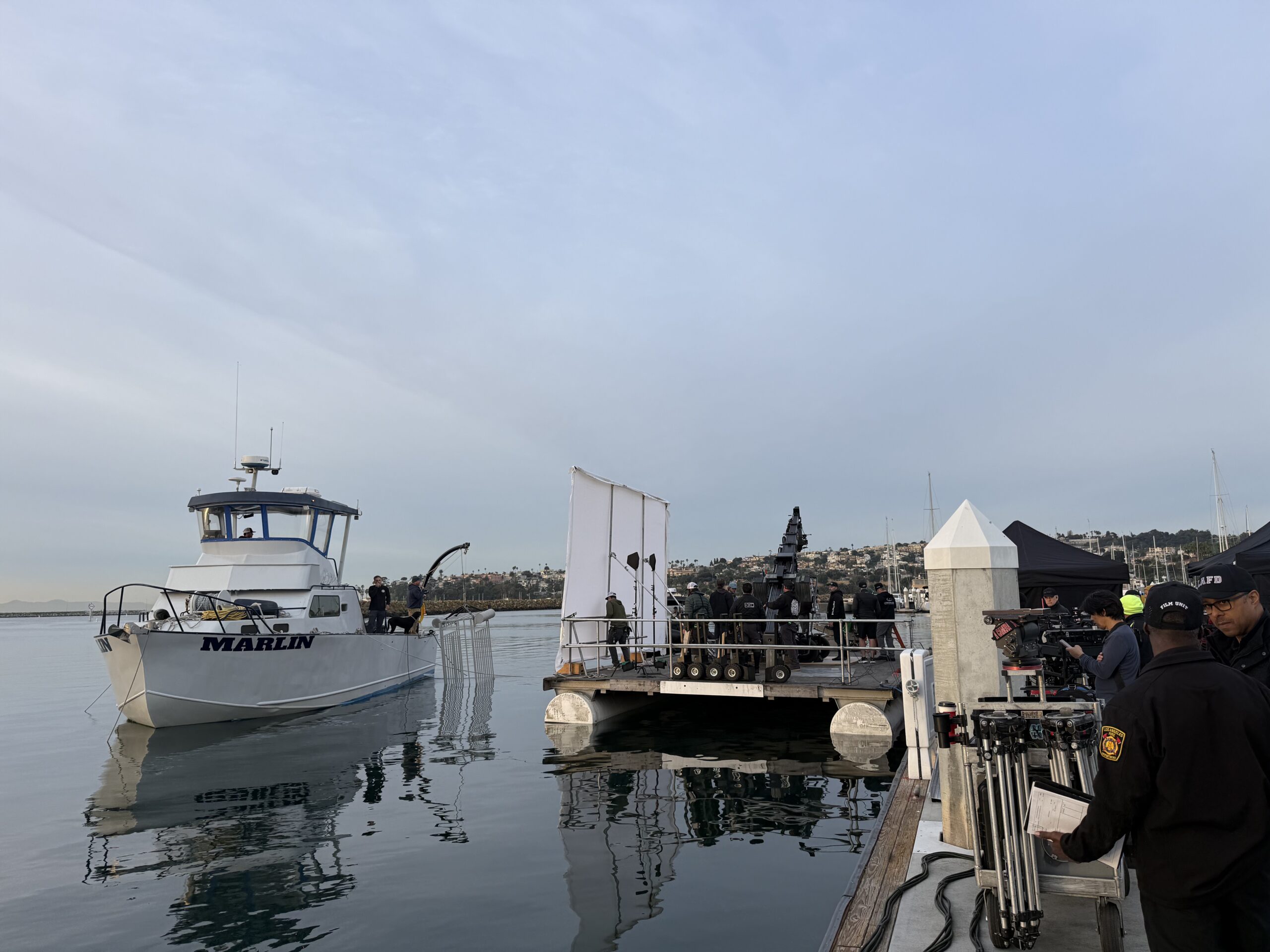
Shark Cage Rigging in Los Angeles: Operating the Lift for a Southwest Airlines Commercial at Cabrillo Way Marina
When O Positive scheduled a Southwest Airlines commercial shoot at Cabrillo Way Marina in San Pedro, the production brought its own marine coordinator and dive team to run the show. What they needed from Myers Marine Division was specific: a stable vessel platform and a five-person rigging crew to operate the shark cage lift for the day. That was our entire scope, and that was what we delivered for the full 11-hour shoot.
This is a short, focused story about a specialist piece of work. The commercial's central gag is the line, "Southwest Airlines is safer than getting lowered into the sea in a shark cage." Making the visual sell that line required a cage that moved exactly when the director called for it, sat exactly where the camera framed it, and came back up the same way every single time. That is shark cage rigging done to film-production standards in Los Angeles, and it is the work our crew was on site to do.
Site Conditions on Arrival
Cabrillo Way Marina sits inside the Port of Los Angeles complex at 2293 Miner Street, San Pedro, protected by the federal breakwater. The water itself was workable. The shoot environment around it was not casual:
- Talent in a cage suspended over open water, with the lift cycle repeated across multiple takes and lighting setups
- A production company of roughly 150 cast and crew staged on land and on the dock, with camera positions on shore and at the end of the dock
- An 11-hour continuous shoot day driven by camera, sun position, and director's call, not by tides or vessel convenience
- Surface chop and wind shifts inside the basin that would walk an unmoored vessel out of frame within minutes
- Production's own marine coordinator and dive personnel managing in-water talent safety and on-set water logistics
- A rigging window that opened with the first take and did not close until wrap
Our piece of that picture was narrow and load-bearing: hold the vessel still, run the lift, deliver the cage to the same spatial mark every time.
Our Approach
We deployed two vessels and a five-person surface crew. The Marlin served as the rigging and lift platform. A secondary support vessel stood by for gear movement and contingency. The full operation ran under OSHA safety standards and the crane-rigging discipline our team maintains as part of its marine operations certifications.
The build-out:
- Vessel quartering on a four-point mooring spread. The Marlin was set on a quartered mooring designed to lock heading and lateral position. Line tension was adjusted across the day to compensate for wind and tide shifts inside the basin, so the platform behaved like a fixed structure between takes.
- Five-person stabilization and rigging crew. Crew responsibilities were divided between mooring-line management, davit winch operation, cage handling, and direct communication with the production's marine coordinator.
- Backup vessel on station. A secondary support vessel was held at standby distance for the full 11-hour shoot for gear runs, line work, and contingency.
- 4,000-pound davit winch operation. A 4,000-lb-capacity davit winch handled cage raise and lower cycles, rigged with certified shackles and a hardware safety factor matched to the loaded cage and two occupants. The winch operator worked off cues coordinated through the production's on-set safety lead.
- Shark cage rigging and load verification. Cage attachment points were inspected before each cycle. Lift bridles were rigged to keep the cage level under load so the camera frame never had to fight a tilted subject.
- Communication discipline. Marine team radio traffic ran on a dedicated channel separate from production comms, with one supervisor as the single point of contact for the production's marine coordinator and the assistant director.
That is a specialist scope. It does not run the shoot. It runs the one thing we were hired to run, well enough that nobody on the production has to think about it.
Project Outcome
The cage went in and came out cleanly for every take across the full 11-hour day. The shoot wrapped on schedule. What the day produced:
- A stable filming platform with no take lost to vessel motion or cage drift
- Repeatable cage immersion cycles across multiple lighting and camera setups
- Zero incidents involving the lift, the rigging, or the Marlin platform
- OSHA-aligned rigging and lift operation on every winch cycle
- A clean subcontractor delivery into a production with its own marine coordinator and dive team, with no overlap, no friction, and no calls for our crew to step outside scope
For production companies, stunt coordinators, and marine coordinators in the Southern California film market who need a specialist crew for cage lifts, davit winch operation, or stabilized platform work as a subcontract piece of a larger water shoot, our marine support services are available out of our Norco, California base. We are comfortable as the lift specialist on a production we are not running. That is what this job was, and that is what we delivered.