
Yacht Salvage in Marina del Rey: Recovering The Admiral From Fire, Mud, and a Second Sinking
When the 100-foot luxury yacht The Admiral caught fire and sank in Basin A of Marina del Rey on the evening of September 18, 2024, the U.S. Coast Guard activated a Unified Command response. Within hours, the wreck had become more than a salvage job. It was an active threat to public safety, marina infrastructure, and the surrounding marine environment. Myers Marine Division was called in to evaluate, mitigate, and recover the vessel.
This is the story of how our commercial dive team executed a complex yacht salvage in Marina del Rey under conditions most operators never encounter: an electrified dock, thousands of gallons of diesel in open water, a 130,000-pound wreck buried under its own collapsed dock, and a vessel that, after the first successful recovery, sank a second time in the Port of Los Angeles before final salvage.
What We Were Up Against
By the time the fire was extinguished and The Admiral settled to the seafloor, the wreck had created a cascading hazard environment. Public reporting from the U.S. Coast Guard and NTSB confirms the scale: approximately 4,000 gallons of red-dye diesel fuel in the water, 1,000 rounds of unspent ammunition and fireworks aboard at ignition, and a vessel that partially sank at the dock in Basin A of Del Rey Landing Marina.
The initial site assessment identified compounding threats:
- Power lines servicing the dock had been lacerated by the fire and collapse, energizing the surrounding water with stray AC current and creating an active electrocution hazard.
- Thousands of gallons of diesel were sheening across the basin, putting the area at extreme risk of secondary ignition from electrical arcing.
- The wreck had sunk during a king tide, the highest tide cycle in a 3 to 4 month window, with several feet of additional water column above the vessel.
- As the king tide subsided, the 130,000-pound vessel pile-drove itself into the marina mud under its own weight. Suction and embedment effectively tripled the lift load, pushing the recovery weight close to 400,000 pounds.
- The dock itself collapsed onto the wreck at low tide, pinning the vessel diagonally beneath its own infrastructure.
Before any diver could enter the water, the electrical hazard had to be neutralized. We coordinated immediate lockout of dock power and brought in a licensed high-voltage electrician to fully disconnect the service. Only then could our ADCI commercial diving team begin the survey dives required to engineer a lift plan.
Dive Plan and Execution
Recovering The Admiral required staged execution across multiple tide cycles. Our team operated under ADCI Consensus Standards and OSHA 29 CFR 1910.401 Subpart T for commercial diving, with surface-supplied air as the primary mode given the diesel-contaminated water column.
The execution sequence:
- Dock removal first. The collapsed dock had to be lifted and floated off the wreck before any salvage of the vessel itself was possible. We timed the dock lift to high tide, when buoyancy could be used to break the seal between the dock structure and the vessel beneath it, then towed the dock clear of the work area.
- Righting the wreck. The Admiral was lying on its port side in heavy mud. Our divers rigged underwater flotation in a controlled cradle configuration, applying buoyancy at engineered attachment points to roll the vessel back to a level orientation without inducing additional hull failure.
- Breaking mud suction. Pulling a 130,000-pound vessel out of marina sediment is not a single-lift event. The embedment had effectively created a vacuum seal. We worked the wreck progressively, alternating lift force with controlled water jetting to break the mud bond before applying full buoyancy.
- Dewatering at the surface. Once buoyancy brought the wreck to the surface, eight high-capacity dewatering pumps were deployed inside the vessel. The engineering principle is straightforward: total pump discharge must exceed total ingress through hull cracks and breaches. With the interior dewatered faster than seawater could flood back in, we identified and patched cracks progressively until the vessel floated under its own residual buoyancy.
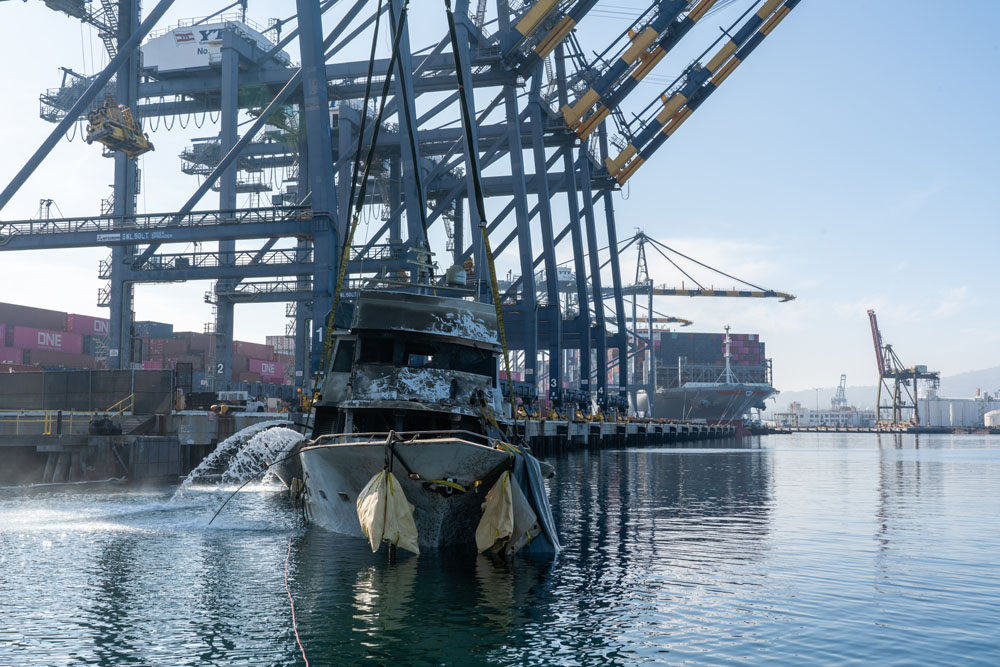
The first salvage took approximately one month of dive operations. After dewatering, the vessel was towed to a holding location at the Port of Los Angeles for further work. Conditions there produced a second incident: the vessel became trapped beneath a catwalk at low tide, and when the tide returned, the catwalk forced the vessel back under. The Admiral sank a second time.
The second recovery called for a different tool set. We mobilized the largest crane in the western United States, deployed significantly larger lift bags, and used surface-supplied divers to refloat the wreck enough to attach a critical crane lift. Once the windows cleared the waterline, dewatering pumps were redeployed and the interior was pumped completely dry. The second salvage was complete in three days.
Safety Protocol Spotlight: Electrified Water and Diesel Hazard Mitigation
This job sat at the intersection of two of the most serious hazards a commercial dive team can face in a marina environment: stray electrical current and floating hydrocarbon fuel. Either one is a potential fatal-event scenario. Combined, they require absolute procedural discipline.
Our hazard mitigation sequence:
- Lockout/tagout of all dock electrical service before any diver entered the water, verified by an independent voltage check.
- Licensed high-voltage electrician dispatched to fully disconnect the service rather than relying on breakers alone, eliminating any possibility of reactivation.
- Continuous air monitoring aligned with the Unified Command response, which included the California Department of Fish and Wildlife and Clean Harbors managing diesel containment.
- No hot work of any kind during the diesel-recovery phase, eliminating any ignition source while volatile vapors remained in the basin.
- Standby diver and tender stationed for every in-water evolution per ADCI Consensus Standards, with emergency egress procedures briefed before each dive.
For more on how our team handles fuel spill response and contamination scenarios, see our environmental response services.
Mission Complete
The Admiral was successfully removed from Marina del Rey and ultimately fully dewatered and stabilized in the Port of Los Angeles. The Unified Command formally concluded recovery operations on October 31, 2024, confirming there was no remaining pollution threat from the vessel.
What the project delivered:
- Elimination of an active electrocution hazard threatening boaters, marina staff, and first responders.
- Recovery of thousands of gallons of diesel fuel from open marina water, protecting Marina del Rey's coastal ecosystem.
- Removal of a 100-foot wreck from a public marina with zero diver injuries across two complex salvage phases.
- Full ADCI and OSHA compliance maintained across every dive evolution during a month-plus operation.
- Demonstrated capability to mobilize and coordinate the largest crane in the western United States for a critical lift.
This is the kind of job that defines what commercial salvage really is. Not a tow. Not a removal. An engineered, hazard-controlled recovery executed by surface-supplied divers, heavy riggers, crane operators, and dive managers working in coordination with federal and state authorities. For project owners, insurers, and marina operators facing similar emergencies, our salvage and recovery operations are mobilized 24/7 from our Norco, California base.