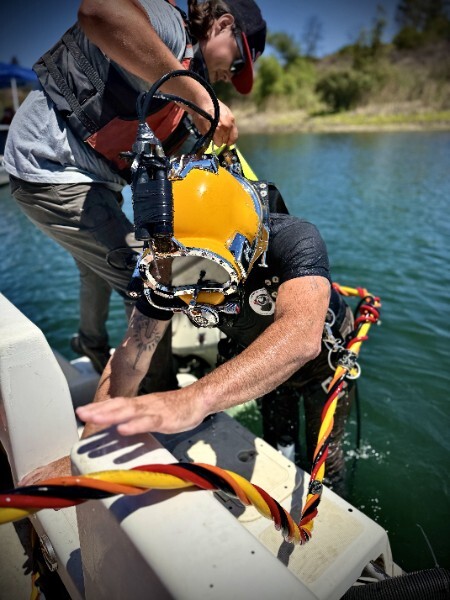
Potable Water Reservoir Diving 100 Feet Down in Lake Jennings
Most potable water diving happens inside a tank. A diver decontaminates, drops through a hatch, vacuums sediment off the floor of a clearwell or standpipe, and comes out. Lake Jennings is a different problem entirely. It is an 85-acre open reservoir in Lakeside, California, owned and operated by Helix Water District, and the work sat 100 feet down on a submerged aeration line that could not be shut off, drained, or brought to the surface.
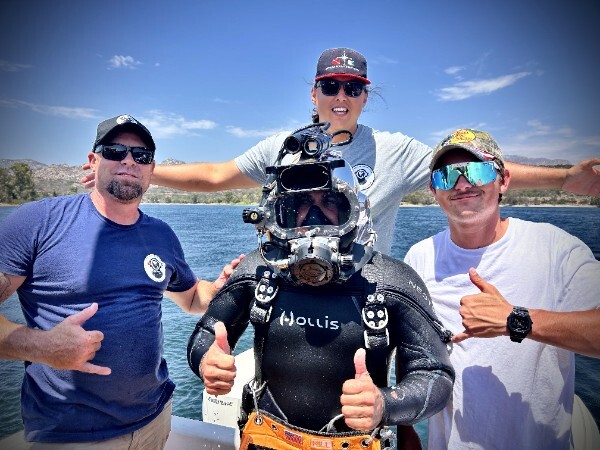
Pacific Hydrotech Corp., the prime contractor on the reservoir's aeration system, brought in Myers Marine Division as the specialist dive contractor to locate and replace two clogged diffuser valves. Two separate locations, both at roughly 100 feet, both critical to a reservoir that feeds drinking water to half a million people.
Finding Two Valves in an 85-Acre Lake
Lake Jennings received a submerged aeration system as part of the upgrades required to store purified water from the East County Advanced Water Purification Program. The system is not decorative. Helix designed it to keep the reservoir continuously mixed so that no more than one percent of new water entering the lake can reach the treatment plant on any given day, a dilution and residence-time standard the state requires before the district can treat that water as lake water. Compressors housed at the rebuilt Chet Harritt Pump Station near the base of the dam feed air down to diffuser lines laid across the reservoir floor.
When individual valves on those lines clog, the mixing pattern degrades. The district loses the uniform aeration the compliance model depends on, and dissolved oxygen falls in the deeper water where thermal stratification would otherwise set in.
The immediate obstacle was not the repair. It was the search. Two small valves, no surface markers, on lines running across the bed of an 85-acre lake, with no reliable way to grid-search 100 feet of water column without burning the entire dive window.
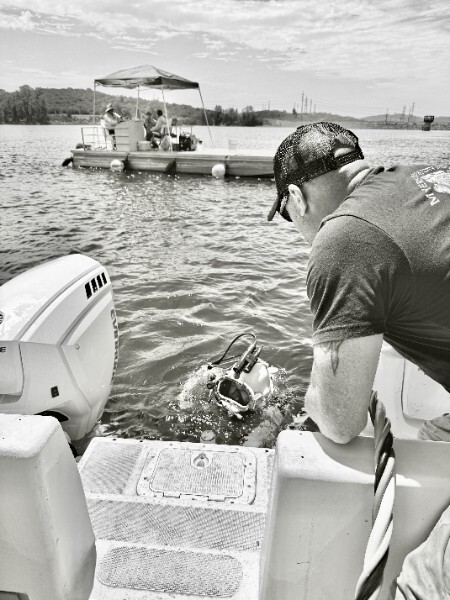
The solution came from the system itself. The crew coordinated with the district to charge the affected pipeline with air. The compromised valves vented, the plume rose, and two discrete patches of disturbed water surfaced above the exact targets. The dive team stopped looking for valves and started looking for bubbles.
Twenty Minutes on the Bottom, No Chamber on Deck
At 100 feet, the dive plan writes itself, and it is unforgiving.
Under 29 CFR 1910.425(c)(1), a surface-supplied air dive that goes deeper than 100 fsw or exceeds the no-decompression limits requires a decompression chamber ready for use at the dive location. Mobilizing a chamber to a remote reservoir shore is a substantial undertaking. The alternative is to build the entire operation so that no diver ever needs one.
That meant every dive had to finish inside the no-decompression limit. The US Navy Air Decompression Table allows 20 minutes of bottom time at 100 fsw before a diver incurs a decompression obligation. Twenty minutes was the ceiling, and it was not a target to approach. It was a hard stop the dive supervisor enforced from the surface.
The spread was built around that number:
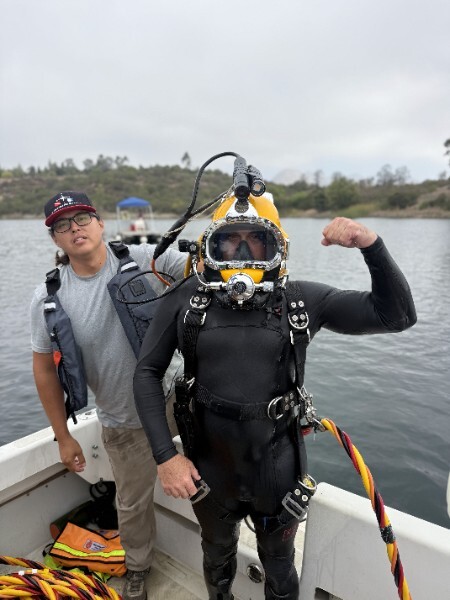
- Full surface-supplied air, not SCUBA, for continuous gas supply and hardwired diver communications
- Primary low-pressure compressor with high-pressure backup cylinders staged and charged on deck
- Dedicated standby diver rigged and ready throughout each dive
- Dive supervisor running bottom time from the surface, per ADCI Consensus Standards
- Tooling staged and pre-rigged topside so the diver arrived at the valve with everything already in hand
The plume-location method paid off exactly where it mattered. Because the divers descended onto a confirmed target rather than searching at depth, the entire allowance went to the repair instead of the hunt. Both valve replacements were completed in under 20 minutes of bottom time each.
Working a Reservoir You Cannot Anchor In
Anchoring in a drinking water reservoir over an active aeration array is not an option. An anchor and chain dragging across the bed risks fouling or severing the very lines the crew was there to service, and it stirs sediment into a water column the district is legally obligated to keep clean.
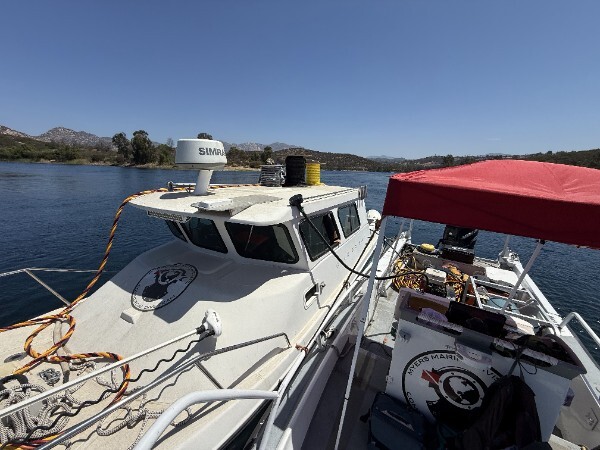
That constraint shaped the vessel plan. Myers ran a two-vessel spread. A heavy support vessel carried the equipment load. The Adventurer, a 25-foot Glacier Bay catamaran, served as the primary operations platform, holding station directly over each bubble plume for the duration of the dive using its positioning system and twin low-emission outboards rather than ground tackle. Its enclosed wheelhouse and 3D structure scanner also gave the supervisor a stable, instrumented station to run the dive from.
The gear arrived as a flyaway spread, two connexes of equipment configured to mobilize anywhere on short notice. It is the same spread Myers deploys for harbor and port work, which is the point. A reservoir 100 feet deep in San Diego County and a berth in a commercial port draw from one inventory that stays current under a scheduled maintenance program.
What Two Valves Mean to 500,000 People
Both valves were replaced. The aeration system returned to full designed output, and the reservoir went back to mixing the way its compliance model assumes.
The stakes on a job like this are easy to understate because the deliverable is so small. Two valves, each replaced in a single short descent. But Lake Jennings is not a recreational lake that happens to hold water. It is the environmental buffer for an indirect potable reuse program, and the water leaving it is treated at the R.M. Levy Water Treatment Plant and distributed to roughly 500,000 people across East County. A degraded aeration system puts the district's ability to meet its dilution standard at risk, and a reservoir that stratifies is a reservoir whose water quality starts working against the treatment plant downstream.
Underwater aeration and diffuser systems belong on the same scheduled maintenance and emergency repair footing as any other submerged asset. They are out of sight, they degrade quietly, and the first visible symptom is usually a water quality number moving in the wrong direction.
Myers Marine Division performs potable water diving across Southern California, from open reservoirs like Lake Jennings to enclosed storage such as the UC Riverside potable water tank inspection. If your district has submerged infrastructure that cannot be drained to be serviced, we can get to it in the water.